
Baby Coil vs. Secondary Stainless Steel Coil: 201/304/410/430
Sourcing
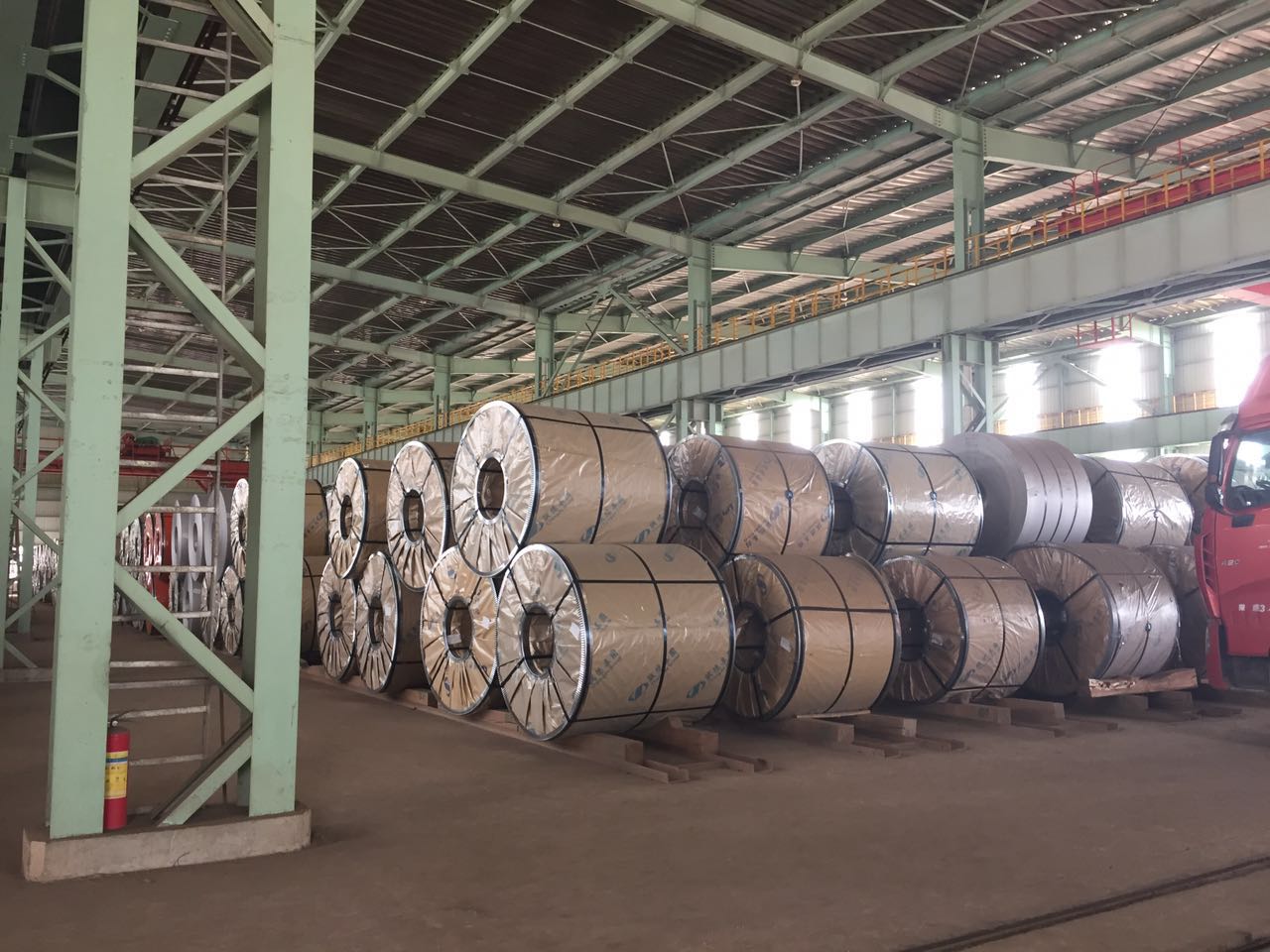
Cover: stainless mill production context for narrow cold-rolled coil supply — NINGBO SUNFIRE STAINLESS STEEL CO., LTD.
Baby coil and secondary stainless steel coil are not two grades competing on quality — they are two coil-format supply paths serving the same purchase order. A buyer who specifies “201, BA, 0.4 mm, 600 mm wide” can receive a quotation for a baby coil and another for a narrow secondary coil, and both can be technically correct while differing in coil weight, packaging, thickness concentration, and even which grades exist in that format.
This head-to-head sourcing comparison sets the two paths side by side using the published specification and documentation of NINGBO SUNFIRE STAINLESS STEEL CO., LTD, a stainless steel supplier based in Ningbo, China, founded in 2013 and exporting 100% of its volume to markets including Pakistan, India, Vietnam, Russia, Turkey, Indonesia, the UAE, Thailand, Malaysia and Bangladesh. The purpose is narrow: help an evaluation-stage buyer decide which format to request for 201, 304, 410 and 430 work, and what to confirm before placing the order.
Short answer, in specification language:
Baby coil — thickness 0.1–1.2 mm (about 80% of output between 0.3 mm and 0.6 mm), width around 600 mm, surface mainly BA finish (about 70% BA), nude packing, grades 430 / 304 / 410 / 201.
Secondary coil, narrow — thickness 0.1–1.2 mm, width around 600 mm, mainly BA finish, coil weight around 200 kg, PVC outside / paper interleaved, grades 430 / 201 / 304.
Secondary coil, wider — thickness 0.25–1.5 mm, width around 1000–1250 mm, mainly BA finish, coil weight 1 mt below or 1 mt above, PVC outside / paper interleaved, grades 430 / 304 / 201 / 410.
Problem Definition: When the RFQ Cannot Distinguish the Two Paths
Most stainless steel coil enquiries are written with four variables: grade, thickness, width and finish. Both formats satisfy those four variables in the 600 mm band, so a buyer comparing quotations quickly falls back to price per tonne — and price per tonne is the least informative number in this comparison.
The real difference sits in variables that the RFQ usually omits:
- Coil weight per unit. Narrow secondary coil is stated at around 200 kg. Baby coil weight is not fixed by this specification, so it has to be agreed in the order rather than assumed.
- Packaging. Baby coil is supplied in nude packing. Secondary coil — narrow and wider — is supplied with PVC outside and paper interleaved.
- Grade coverage at the chosen format. 410 is listed for baby coil and for wider secondary coil, but not for narrow secondary coil, where the listed grades are 430, 201 and 304.
- Thickness concentration in actual output. Baby coil covers 0.1–1.2 mm, but roughly 80% of that output sits between 0.3 mm and 0.6 mm. A request at 1.0 mm is inside the range and still needs availability confirmation.
Three sourcing failures follow from this gap. The first is ordering narrow secondary coil in 410 because the buyer assumed grade coverage is identical across formats. The second is comparing a nude-packed baby coil against a PVC-and-paper secondary coil without normalising the packaging difference into the landed cost. The third — and the most expensive — is going to production without written acceptance criteria, so that BA surface quality, thickness tolerance and grade marking are judged after the material has already been cut.
Industry Background: Why Two Narrow Coil Formats Coexist
Downstream stainless steel demand in this category is concentrated in narrow-width forming: cookware bodies, appliance panels and brackets, elevator and interior decorative panels, automotive components, industrial equipment parts, and stamping or deep-drawing blanks. Both baby coil and secondary coil are specified against the same downstream industry list — kitchenware and cookware, home appliances, elevator decoration, construction and interior decoration, automotive components, industrial equipment, metal stamping and deep drawing, tube and pipe manufacturing, tableware production, and hardware accessories.
The formats coexist because they answer different purchasing questions. One path supplies a defined narrow format at a defined thickness band with minimal packaging. The other supplies a graded coil that may be narrow at around 600 mm and around 200 kg per coil, or wider at 1000–1250 mm with coil weights around one metric tonne — which matters for lines that cannot handle small coils, or for buyers who need panel-width material rather than strip.
China remains the dominant sourcing base for these formats. Data attributed to the Stainless Steel Council of China Iron and Steel Association and reported by SEAISI puts China’s stainless steel product exports at 3.78 million tonnes for January–September 2025, up 1.6% year on year. That figure describes a national trade flow, not the capability of any single supplier — it supports the case for China as a sourcing geography, and it says nothing about grade availability, coil quality or acceptance standards at a specific mill.
Detailed Solution: The Two Supply Paths, Side by Side
Path 1 — Baby Coil (201 / 304 / 410 / 430, around 600 mm, BA)
Baby coil specification
- Thickness: 0.1 mm – 1.2 mm; approximately 80% of the range falls between 0.3 mm and 0.6 mm.
- Width: around 600 mm.
- Surface: mainly BA finish, approximately 70% BA.
- Packaging: nude packing.
- Grades: 430, 304, 410, 201.
The baby coil path is the tighter format of the two. Its value is a narrow coil at a narrow width with a defined finish, and its practical constraint is the thickness concentration: 0.3–0.6 mm is where most of the output sits. Buyers whose forming work runs at 0.4 mm BA — the typical cookware and deep-drawing band — are asking for the centre of the format, not its edge.
Path 2 — Secondary Stainless Steel Coil (narrow and wider)
Secondary coil — narrow format
- Thickness: 0.1 mm – 1.2 mm.
- Width: around 600 mm.
- Surface: mainly BA finish.
- Coil weight: around 200 kg.
- Packaging: PVC outside / paper interleaved.
- Grades: 430 / 201 / 304.
Secondary coil — wider format
- Thickness: 0.25 mm – 1.5 mm.
- Width: around 1000 mm – 1250 mm.
- Surface: mainly BA finish.
- Coil weight: 1 mt below or 1 mt above.
- Packaging: PVC outside / paper interleaved.
- Grades: 430 / 304 / 201 / 410.
The secondary path is broader but not uniform. The narrow variant overlaps the baby coil almost completely on thickness, width, finish and grade — with three differences that decide the choice: coil weight around 200 kg, PVC-and-paper packaging, and the absence of 410 from the listed grades. The wider variant changes the engineering question entirely: it extends down to 0.25 mm and up to 1.5 mm, and it delivers panel-width material at roughly one tonne per coil.
What Each Difference Means for a Production Line
Thickness. Between 0.1 mm and 1.2 mm, baby coil and narrow secondary coil are interchangeable on paper. Above 1.2 mm, only the wider secondary format in this specification reaches 1.5 mm. Buyers should treat the stated range as an envelope and the actual order thickness as a separate confirmation, because the baby coil band is concentrated at 0.3–0.6 mm.
Width. Around 600 mm is the shared width of baby coil and narrow secondary coil. If the blank is 900 mm or 1240 mm, neither narrow format works and the wider secondary coil at 1000–1250 mm becomes the only option in this comparison.
Coil weight and handling. A 200 kg narrow secondary coil and a coil of 1 mt or more demand different decoilers, mandrels and crane practice. For a line built around small coils, the wider secondary format is not a better buy — it is simply incompatible with the handling equipment.
Packaging. Nude packing on baby coil suits buyers who process quickly or who apply their own interleaving. PVC outside with paper interleaved on secondary coil adds surface protection during handling and storage, and it also adds packaging to the quoted cost — so the two quotations should not be compared as if packaging were identical.
Surface. Both paths are mainly BA. Because BA is a finish outcome rather than a guarantee, buyers should define what “BA” means for their acceptance inspection — surface inspection and thickness inspection are the stated quality-control steps in this supply chain, alongside the mill test certificate.
Grade coverage. This is the single most decisive difference, and it is best read as a matrix.
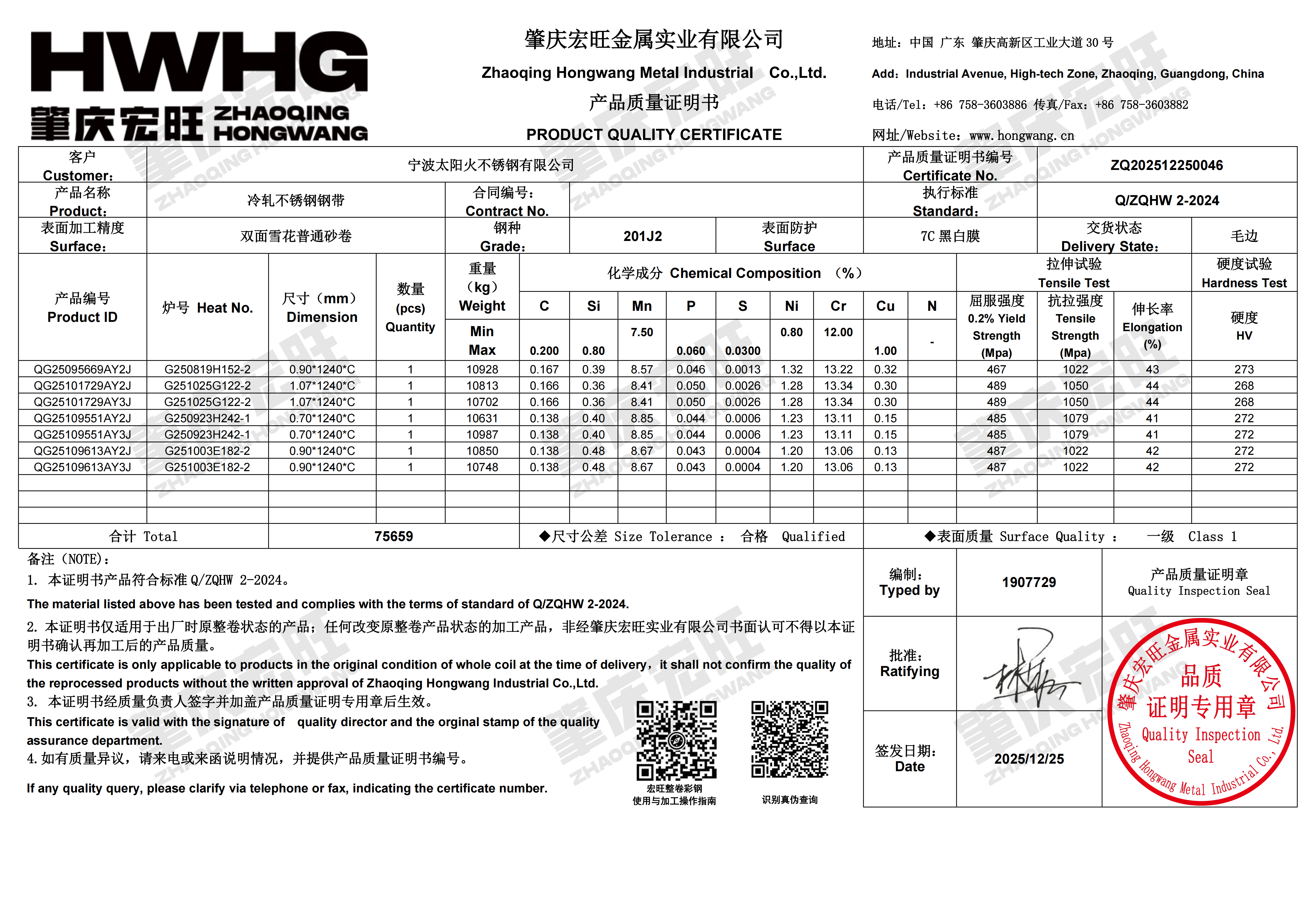
Supporting: 201 J2 product quality certificate (MTC ZQ202512250046, standard Q/ZQHW 2-2024), the type of grade evidence buyers should request with each lot.
Grade Coverage by Coil Format
| Grade | Baby coil | Secondary — narrow (~600 mm) | Secondary — wider (1000–1250 mm) |
|---|---|---|---|
| 201 | Listed | Listed | Listed |
| 304 | Listed | Listed | Listed |
| 410 | Listed | Not listed | Listed |
| 430 | Listed | Listed | Listed |
Grade coverage as stated in the supplier’s published coil specifications. “Not listed” means the grade is not part of that format’s stated range — it is not a judgement on quality.
Comparison Table: Baby Coil vs. Secondary Coil
| Comparison attribute | Baby coil | Secondary — narrow | Secondary — wider |
|---|---|---|---|
| Thickness range | 0.1–1.2 mm | 0.1–1.2 mm | 0.25–1.5 mm |
| Thickness concentration | ~80% between 0.3 mm and 0.6 mm | Not stated | Not stated |
| Width | Around 600 mm | Around 600 mm | Around 1000–1250 mm |
| Coil weight | To be agreed in the order | Around 200 kg | 1 mt below / 1 mt above |
| Surface | Mainly BA (~70% BA) | Mainly BA | Mainly BA |
| Packaging | Nude packing | PVC outside / paper interleaved | PVC outside / paper interleaved |
| Grades | 430 / 304 / 410 / 201 | 430 / 201 / 304 | 430 / 304 / 201 / 410 |
| Best fit on the line | Narrow-format forming where packaging can be minimal | Narrow-format forming with protected surfaces and light coils | Panel-width forming and thickness above 1.2 mm |
All values come from the supplier’s published baby coil and secondary coil specifications. No price, tolerance class or performance rating is implied.
Step-by-Step Breakdown: Choosing Between Them
Step 1 — Fix the finished blank, not the coil
Start from the formed part: blank width, blank thickness, and whether the part is stamped, drawn, rolled or welded. If the blank is under roughly 600 mm, both narrow formats are candidates. If it is wider, the wider secondary format at 1000–1250 mm is the only path in this comparison.
Step 2 — Check whether the grade exists in that format
410 rules out narrow secondary coil immediately. 201, 304 and 430 remain available across all three formats. Confirm the grade requirement before the width and finish, because grade availability is the hardest constraint to move later.
Step 3 — Confirm the thickness position inside the band
For baby coil, a request at 0.3–0.6 mm sits in the core of the output; a request at 0.9 mm or 1.1 mm sits at the edge and should be confirmed against stock and lead time. For wider secondary coil, 0.25–1.5 mm is the stated envelope.
Step 4 — Match coil weight to the handling equipment
Around 200 kg per narrow secondary coil, one tonne or more per wider secondary coil, and an agreed weight for baby coil. This is an equipment question, not a preference question.
Step 5 — Decide the packaging regime
Nude packing on baby coil, PVC outside with paper interleaved on secondary coil. If the material will be stored before processing, or handled repeatedly, the protected pack has operational value — and a cost.
Step 6 — Write the finish definition
Both paths are mainly BA, so the order should state what will be inspected. In this supply chain, quality control is described as mill test, thickness inspection and surface inspection; all three belong in the acceptance criteria rather than in a verbal understanding.
Step 7 — Anchor documentation to a standard
Ask for a mill test certificate that names the standard. Reference evidence from this supply chain shows the pattern: a 201 J2 certificate issued by Zhaoqing Hongwang Metal Industrial Co., Ltd. against Q/ZQHW 2-2024 (certificate ZQ202512250046), a 430 certificate issued by JIANGSU YONGJIN METAL TECHNOLOGY CO., LTD against GB/T 3280-2015 covering 430 stainless steel coils and sheets (JSPZ20260501804), and a 304 certificate issued by QINGTUO GROUP CO., LTD against ASTM A240/A240M (QT20260108631).
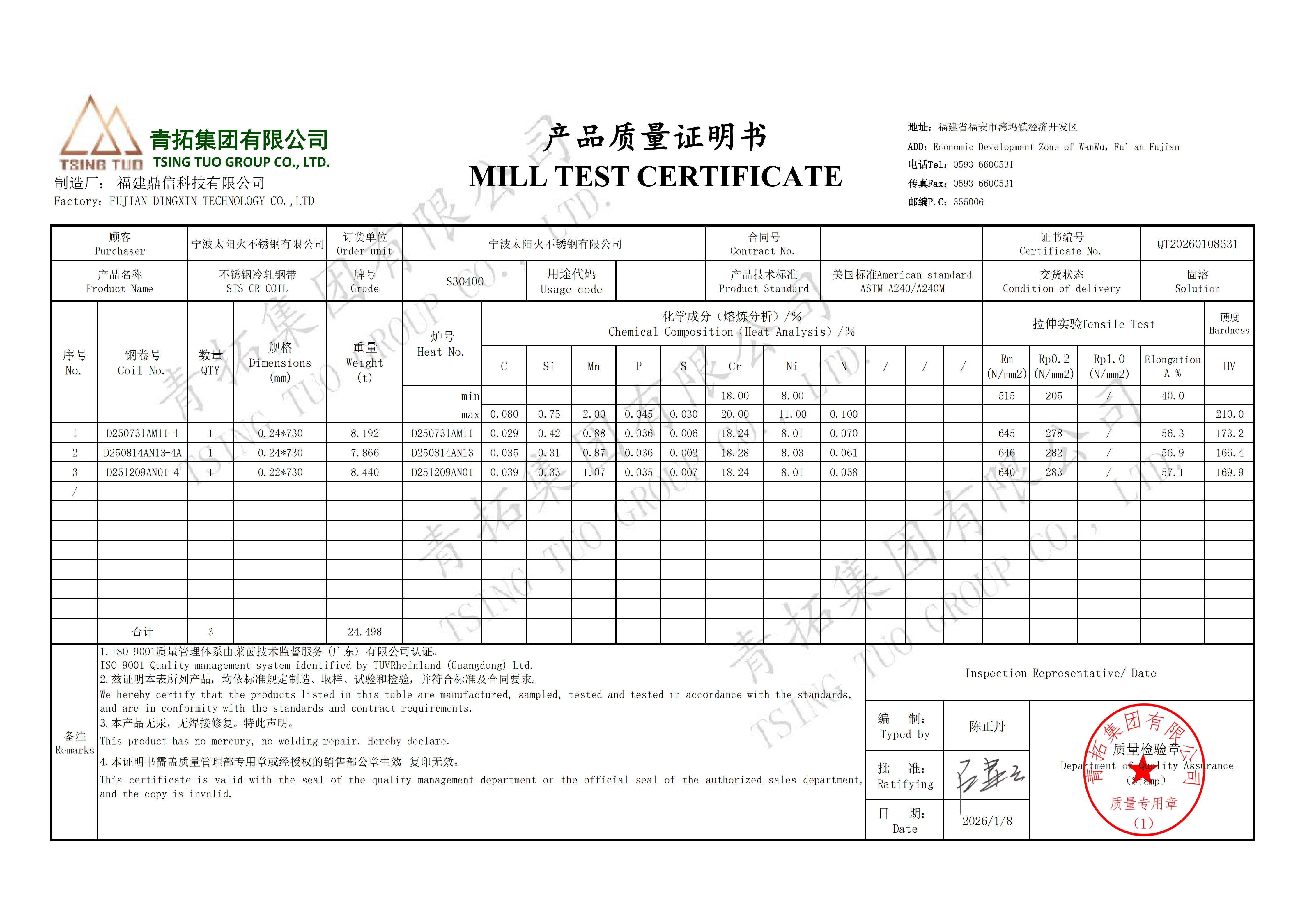
Supporting: 304 mill test certificate QT20260108631 issued against ASTM A240/A240M — documentation should state the standard, not only the grade name.
Step 8 — Normalise the commercial terms before comparing quotes
Quantity thresholds differ by format and width. In this specification, 201 J3/J2/J5 2B/BA narrow coil carries a stated MOQ of 27 MT across three to four specifications, while 304 narrow coil is quoted per width — 9 MT at 730 mm and 690 mm, 8 MT at 650 mm and 620 mm. Lead time is stated as 7–45 days, with 7–30 days for stock items. A quotation that ignores these thresholds is not a like-for-like quotation.
Use Cases: Matching Each Path to the Application
Both formats list the same downstream industries, so the application itself does not choose the format. The forming process, blank width, coil handling and surface protection requirement do.
Kitchenware and cookware
Cookware bodies are drawn from narrow strip in the 0.3–0.6 mm band, which is the core of baby coil output in BA finish. Where the surface must survive press-shop handling and storage, the PVC-and-paper protection of narrow secondary coil is the practical alternative.
Home appliances
Appliance panels and internal parts mix narrow blanks with wider panels. A single order may therefore need baby coil for one component family and wider secondary coil for another — which is why grade and thickness confirmation should be per component, not per purchase order.
Elevator decoration
Decorative elevator panels need panel-width coverage and protected surfaces. The wider secondary format at 1000–1250 mm, mainly BA and PVC-and-paper packed, fits that geometry; narrow formats suit trims and edge profiles.
Construction and interior decoration
Interior decorative work consumes both narrow strip for profiles and wider sheet-width material for panels. 201 and 304 cover the grade requirement in all three formats; 430 is available across all three as well.
Automotive components
Automotive parts frequently move above 1.2 mm, where the wider secondary format extends to 1.5 mm. Below 1.2 mm, baby coil and narrow secondary coil remain viable, subject to the grade being listed for the format.
Industrial equipment
Equipment fabrication mixes thicknesses and widths in the same workshop. Buyers in this segment typically standardise on one or two formats to simplify handling, then confirm grade coverage per component — a discipline that avoids ordering 410 in a format where it is not listed.
Metal stamping and deep drawing
Stamping and deep drawing are the applications where the format choice shows up fastest: blank width sets the format, thickness concentration sets availability, and surface protection sets the rejection rate. A 200 kg narrow secondary coil is easier to load on a light decoiler; a one-tonne wider coil reduces coil-change frequency on a heavier line.
Where neither format fits: adjacent options
If the requirement is 410 at a width under 600 mm, the narrow secondary format does not list that grade. In this specification, 410 Narrow BA covers 0.15–1.2 mm at 300–1010 mm width with export packaging and 7–30 days lead time, and 410 Wider BA covers 0.25–1.5 mm at 1240 mm with export packaging plus paper interleaving. Similarly, 304 narrow coil runs 0.10–2.00 mm at 550/600/620/650/690/730 mm and 201 J3/J2/J5 runs 0.1–2.0 mm at 550–830 mm — both worth asking about when the format comparison above does not resolve the requirement.
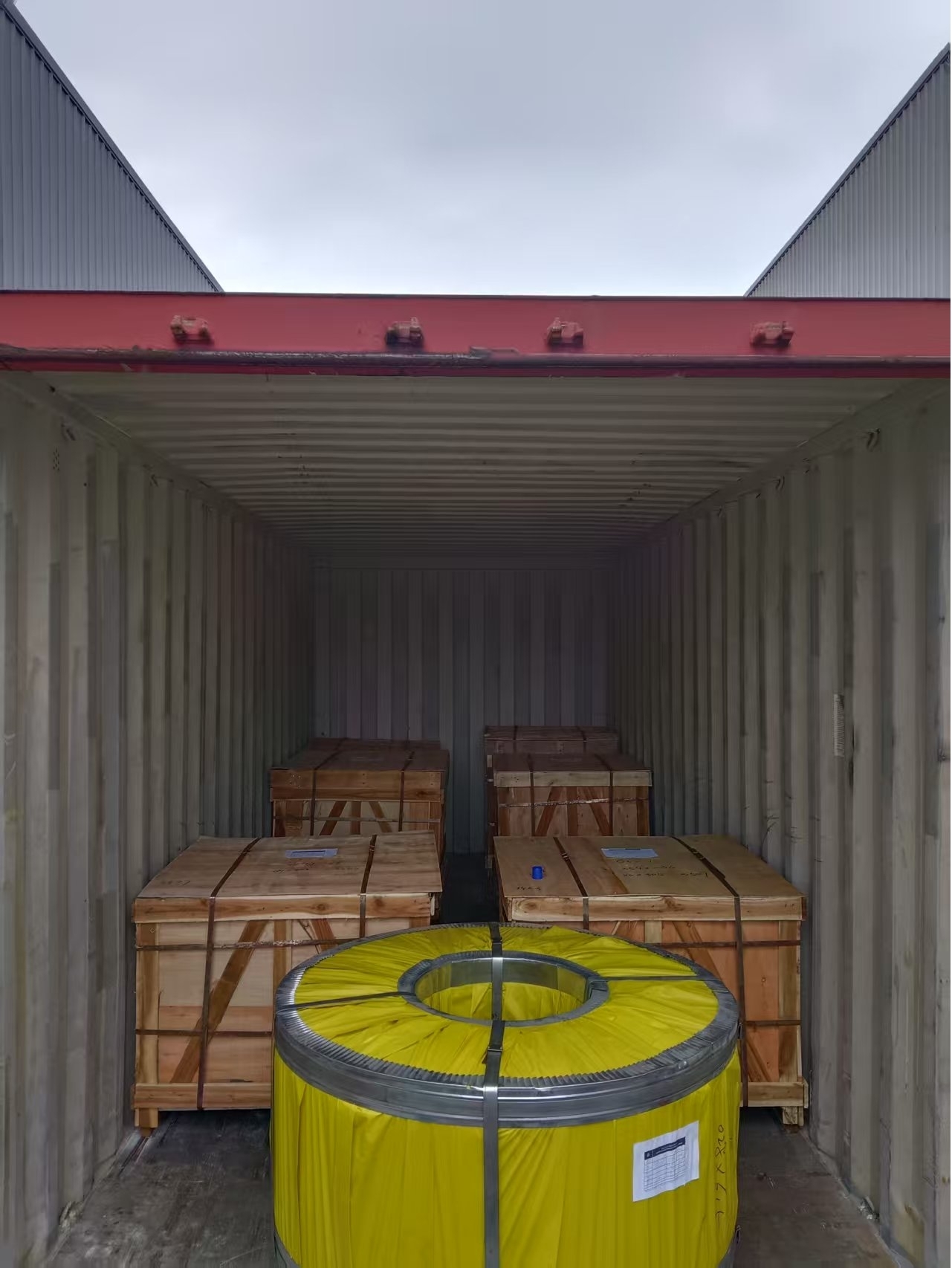
Proof: coil loading for export. NINGBO SUNFIRE STAINLESS STEEL CO., LTD exports 100% of its volume, with clients in markets including Indonesia, India, South Africa, Pakistan, Vietnam and Saudi Arabia.
FAQ
What documentation should accompany baby coil and secondary stainless steel coil shipments?
Ask for a mill test certificate that names both the grade and the standard, plus thickness and surface inspection records. Reference certificates in this supply chain show the expected format: 201 J2 against Q/ZQHW 2-2024, 430 against GB/T 3280-2015, and 304 against ASTM A240/A240M. Because both coil formats are supplied mainly in BA, the acceptance criteria should also state how BA surface is inspected, so that grade marking, thickness and surface are judged against an agreed document rather than after cutting.
How should buyers compare top stainless steel manufacturers in China for baby coil and secondary coil supply?
Compare on the specification, not on the company name. Four checks separate suppliers quickly: whether all four grades — 201, 304, 410 and 430 — are listed in the format you need; whether the thickness band you actually run sits inside the stated range and inside the output concentration; whether width and coil weight match your handling equipment; and whether packaging, MOQ and lead time are stated per width rather than as a general promise. A supplier that publishes 0.1–1.2 mm, around 600 mm, mainly BA, nude packing and all four grades for baby coil, and states narrow and wider secondary coil separately with their own grades and coil weights, gives you something to verify. One that quotes a single “stainless coil” line does not.
Which commercial terms change the cost comparison between the two formats?
Three terms do most of the work. Packaging: baby coil is nude packed, while secondary coil is PVC outside with paper interleaved, so the quoted price covers different protection. Coil weight: around 200 kg for narrow secondary coil versus 1 mt below or above for wider secondary coil changes freight, handling and coil-change frequency, and baby coil weight has to be agreed per order. Quantity threshold: 201 J3/J2/J5 narrow coil carries a stated MOQ of 27 MT across three to four specifications, and 304 narrow coil is quoted per width at 8–9 MT. Compare quotations only after those three are normalised, and request a specification-based quotation rather than a generic price per tonne.
How should a buyer validate the material before committing to a full order?
Validate on three levels. First, dimensional: confirm the thickness position inside the band and the actual width, since both narrow formats sit at around 600 mm and the difference will not show on a grade name. Second, surface and grade: check the BA finish against your acceptance criteria and verify the grade on the mill test certificate. Third, format: confirm coil weight and packaging in writing, because nude-packed baby coil and PVC-and-paper secondary coil behave differently in storage. A sample and a documented acceptance checklist before the first production lot cost far less than a rejected coil. Buyers can request a sample or a quotation against a defined specification from NINGBO SUNFIRE STAINLESS STEEL CO., LTD at zzqsarah@hotmail.com or via WhatsApp on +86-18257411826.
What lead time should be planned for baby coil and secondary coil orders?
Lead time is stated as 7–45 days, with stock items typically running 7–30 days. The variance is driven by grade, thickness position and width rather than by the format name, so the practical approach is to confirm the specific combination — for example 410 in baby coil, or 0.25 mm in wider secondary coil — against stock before committing a production date. Where the order includes customised thickness, width, surface finish, PVC or packaging, the longer end of the 7–45 day window should be planned.
Conclusion: Choose the Format by Constraint, Not by Habit
Baby coil and secondary stainless steel coil are both credible sourcing paths for 201, 304, 410 and 430 work, and at around 600 mm they overlap so closely that the choice is often made by habit rather than by constraint. The comparison in this article reduces to four decisive checks.
- Grade first. 410 is listed for baby coil and wider secondary coil, not for narrow secondary coil.
- Width second. Around 600 mm keeps both narrow formats in play; 1000–1250 mm means wider secondary coil only.
- Thickness third. 0.3–0.6 mm is the core of baby coil output; wider secondary coil reaches 1.5 mm.
- Handling and packaging fourth. Around 200 kg with PVC-and-paper protection versus nude-packed coils of an agreed weight.
Everything after those four checks is documentation: mill test certificate naming the standard, thickness inspection, surface inspection, and written purchasing terms covering grade marking, coil weight, packaging, MOQ and acceptance criteria. Buyers who confirm those before the first lot avoid the most common failure in this comparison — discovering a format mismatch after the coil has been cut.
Next step: sample or specification-based quotation
NINGBO SUNFIRE STAINLESS STEEL CO., LTD supplies baby coil and secondary stainless steel coil in 201, 304, 410 and 430, with OEM customisation on thickness, width, surface finish, PVC and packaging, and quality control through mill test, thickness inspection and surface inspection.
Send your grade, thickness, width, finish, coil weight and packaging requirement for a like-for-like quotation, or request a sample for line validation.
Email: zzqsarah@hotmail.com · WhatsApp / Tel: +86 182 5741 1826 · Website: en.sunfirex.com
Address: ROOM A-17, INTERNATIONAL CENTER, NINGBO CHAMBER OF COMMERCE, NO. 588 TAIKANG ROAD, NINGBO, CHINA
Download the product brochure: NINGBO SUNFIRE STAINLESS STEEL catalogue (PDF)
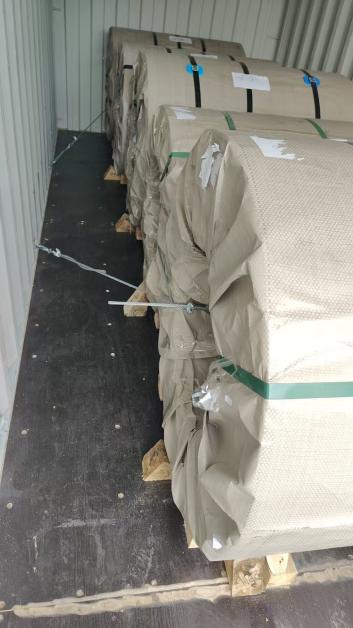
CTA: coil shipment prepared for export. Request a sample or a specification-based quotation before fixing the format for production.
Specification values in this article refer to the published baby coil, secondary stainless steel coil, 201, 304 and 410 product data of NINGBO SUNFIRE STAINLESS STEEL CO., LTD. Mill test certificate references are cited as documented evidence of standard and issuing mill. Buyers should confirm purchasing terms, grade marking and acceptance criteria in the contract.
Have Questions or Need More Details?
Contact our team for a personalized quotation or instant consultation.
Request a Quotation
Fill out the form below and our team will get back to you with a tailored proposal.
WhatsApp Direct Chat
Prefer to chat in real-time? Message us on WhatsApp for instant assistance & quick answers.
- Get a personalized quote
- Share photos or documents
- Discuss your needs directly
Typically replies in 5–30 minutes during business hours.