Evaluating Secondary Stainless Coil Suppliers: Weight, Finish and Grade Integrity Checks
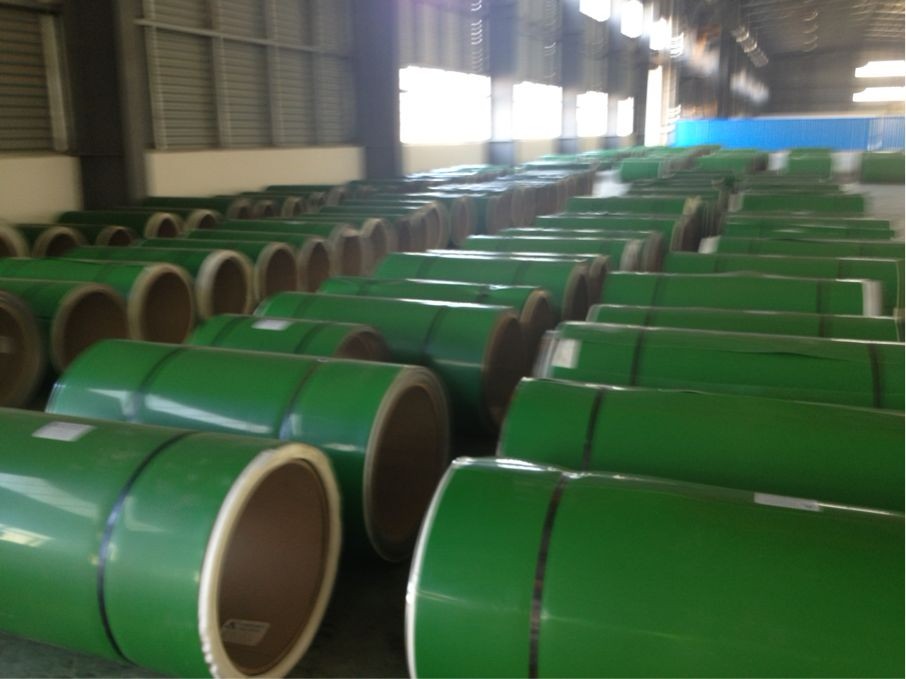
430 secondary stainless steel coils — the format under evaluation: weight band, finish share and grade declaration.
Three checks decide whether a secondary stainless steel coil supplier is worth qualifying: coil weight variance, finish consistency and grade integrity. For the narrow secondary format, the recorded baseline is a thickness range of 0.1 mm–1.2 mm, a width around 600 mm and coil weights around 200 kg. The wider secondary format runs 0.25 mm–1.5 mm thick at around 1000 mm–1250 mm wide, with coils supplied 1 mt below or 1 mt above. Surface is described as mainly BA finish, and for baby coil the recorded share is 70% BA finish — a number a buyer can actually audit.
NINGBO SUNFIRE STAINLESS STEEL CO., LTD is a Ningbo-based stainless steel supplier founded in 2013 that specialises in stainless steel and stainless steel products, with a stated advantage in secondary and baby coil. This article is written for buyers in the research and evaluation stages who need to test a supplier's offer against their own line capability — lifting equipment, payoff systems, downstream finishing and grade documentation — before releasing a first purchase order.
Why Secondary Coil Breaks Normal Supplier Evaluation
Secondary coil is not defined by a single specification. It is defined by its position in the mill's output, which means one lot can contain material that differs in weight, width, thickness and surface finish. Two buyers can both order "secondary 430" and receive metal that behaves differently on the same machine.
The product data behind this article records two clearly separated secondary formats, and the difference between them is the whole basis of evaluation:
- Secondary-narrow — thickness 0.1 mm–1.2 mm, width around 600 mm, surface mainly BA finish, coil weight around 200 kg, packaging PVC outside or paper interleaved, grades 430 / 201 / 304.
- Secondary-wider — thickness 0.25 mm–1.5 mm, width around 1000 mm–1250 mm, surface mainly BA finish, coil weight 1 mt below or 1 mt above, packaging PVC outside or paper interleaved, grades 430 / 304 / 201 / 410.
A third format sits alongside them: baby coil, supplied at 0.1 mm–1.2 mm thickness and around 600 mm width, surface mainly BA finish with a recorded 70% BA finish share, in nude packing, across grades 430 / 304 / 410 / 201.
This is why a price per tonne that does not state format, weight band and finish share is not really a price. It is an opening position, and comparing two of them is comparing two different products. The evaluation work starts before the quotation, not after it.
Industry Background: More Coil, More Variability to Screen
Availability is not the constraint in this market. The global stainless steel market was valued at USD 135.8 billion in 2025 and is projected to reach USD 247.4 billion by 2033, according to Grand View Research. China's stainless steel exports reached an all-time high of 5.04 million tonnes in 2024, a 25.6% increase year on year, according to General Administration of Customs data reported by Mysteel. Cold-rolling capacity continues to build across the region: Hongwang Group, a producer specialising in cold-rolled stainless steel, operates an Indonesian joint venture with 700,000 tonnes per year of cold rolling capacity.
More cold-rolled output means more narrow, secondary and baby coil reaching the market. It also means more lot-to-lot variability for buyers to screen, because secondary formats are where the variation concentrates. On the export side, trade conditions stay active: EU anti-dumping duties on stainless steel cold-rolled flat products from China and Taiwan, in the range of 24.6% to 28.5%, were maintained following a 2025 expiry review under European Commission Regulation 2025/1573. Documentation quality and grade declaration therefore carry commercial weight, not only technical weight.
Demand pulls in the same direction. Narrow and secondary coil feed kitchenware and cookware, home appliances, construction and interior decoration, tube and pipe manufacturing, metal stamping and deep drawing, tableware production and hardware accessories. Those processes rarely need a full mill-width coil. What they need is a predictable one, lot after lot — which is a supplier-evaluation problem rather than a sourcing-volume problem.
The Four Verification Axes
1. Weight Variance: Around 200 kg Narrow Coil Versus Coils Below or Above 1 mt
Coil weight is usually filed under logistics. In secondary coil it is a production variable, and it changes what a line can physically do.
At around 200 kg per coil, narrow secondary coil can be moved with light lifting equipment and used in workshops where crane capacity is limited. The trade-off is changeover frequency: a 200 kg coil leaves the line sooner, so a tube mill or stamping press fed with narrow coil will stop more often for reloading. Wider secondary coil, supplied at 1 mt below or 1 mt above, cuts the number of changeovers considerably — but it requires lifting gear, a compatible mandrel and a payoff system rated for that weight, and it raises the cost of a single defective coil because more metal sits behind one defect.
Weight also drives costing. Yield calculations, freight planning and container loading all depend on actual rather than nominal weight. The practical test is straightforward: ask for the actual weight record of the last three lots in your target format and look at the spread, not the average. A supplier whose weights cluster tightly inside the stated band is easier to plan around than one whose weights merely fall somewhere within it.
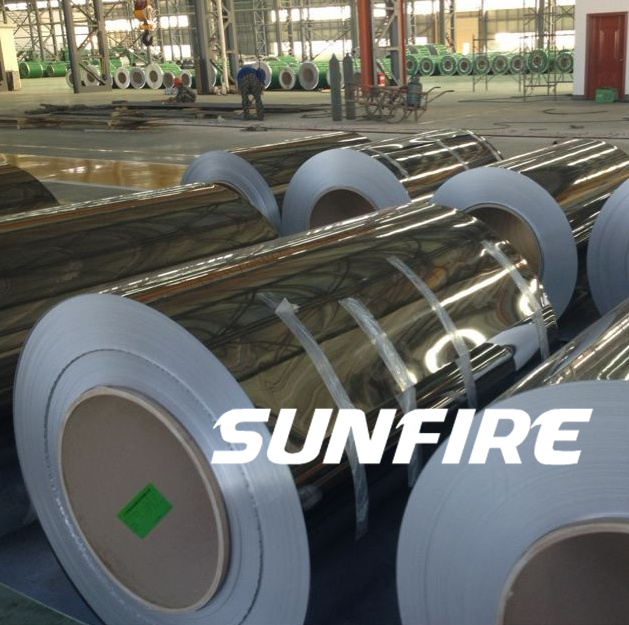
Wider secondary coil: 0.25 mm–1.5 mm thickness, around 1000 mm–1250 mm width, 1 mt below or 1 mt above per coil.
2. Width and Thickness: Around 600 mm and 0.1–1.2 mm as a Baseline Acceptance Check
The narrow secondary format is recorded at 0.1 mm–1.2 mm thickness and a width around 600 mm. Those two figures work as a baseline acceptance test because they define the strip envelope most narrow-format downstream equipment is set up to run, and because they are specific enough to write into a specification rather than leave to interpretation.
Two conditions should be confirmed in writing rather than assumed:
- Edge condition. Whether the coil arrives mill edge or slit edge changes how it runs on a tube mill and on stamping equipment. Slitting machines, tube mills and stamping equipment are the processing equipment this material is normally matched to, so the edge condition is part of the fit, not a finishing detail.
- Thickness stability. Application data for stainless steel processed into food processing, architectural decoration, home appliance manufacturing and automotive parts lists stable thickness tolerance alongside mirror finish and anti-rust as a special requirement. Thickness stability is what makes the thin end of the 0.1 mm–1.2 mm band usable in production.
For the wider format the baseline shifts upward: 0.25 mm–1.5 mm thickness at around 1000 mm–1250 mm width. Baby coil occupies the narrow band again at 0.1 mm–1.2 mm and around 600 mm width, with 80% of production falling between 0.3 mm and 0.6 mm — a useful signal, because it tells a buyer where the supplier's stock concentration actually sits.
3. Finish Consistency and the 70% BA Disclosure Test
"Mainly BA finish" is a description. "70% BA finish" is a commitment. The gap between those two phrasings is where most finish disputes originate.
The recorded finish position for the secondary formats is mainly BA finish. For baby coil, the product data states mainly BA finish and specifies 70% BA finish. That disclosure is the most useful transparency test available at the evaluation stage, because it tells a buyer three things at once:
- The supplier knows the composition of its own stock instead of describing it in general terms.
- The remaining share is implicitly acknowledged — a supplier stating 70% is telling you that roughly 30% is a different finish.
- The number can be checked against a delivered lot, which makes the claim falsifiable rather than rhetorical.
Finish also interacts with downstream processing. BA (bright annealed) is normally chosen where a brighter, smoother surface is required than standard 2B provides. Where the buyer's next step is polishing, the base finish becomes an input to that process rather than a cosmetic property: 8K mirror finish is produced by iterative polishing, and 12K represents the highest reflectivity tier, resembling a glass mirror. A base finish that varies across a lot makes those polishing results harder to hold consistent, which is why finish disclosure should be tested on panels taken from the actual delivered lot rather than from a reference library. Packaging should be inspected at the same time — PVC outside or paper interleaved on secondary coil, nude packing on baby coil.
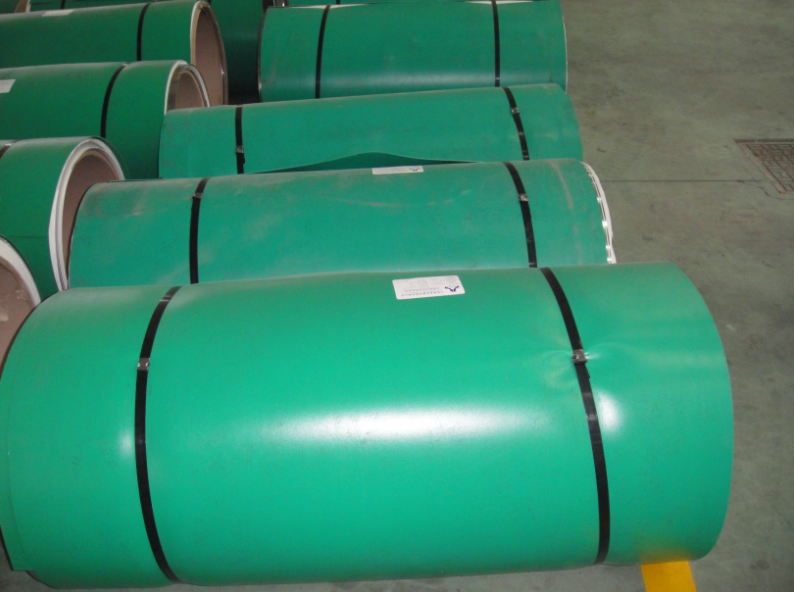
Finish consistency is checked on panels from the delivered lot, not from a reference sample library.
4. Grade Integrity: 201, 304, 410 and 430 Backed by Mill Test Evidence
Grade is the claim most often taken on trust and the most expensive one to get wrong. The secondary formats covered here list grades 430, 201 and 304 in the narrow format, and 430, 304, 201 and 410 in the wider format. Baby coil lists 430, 304, 410 and 201.
Two verification points matter more than the rest:
- The designation must be complete. Product data for 201 stainless steel distinguishes 201 J3 / J2 / J5 in 2B and BA finishes. A supplier that answers "201" without naming the J-series has answered half a question, and the half that is missing is the half that determines forming behaviour.
- The document trail must match the metal. ASTM A240 and ASME SA240 are the core international standards for stainless steel plate, sheet and strip used in general and pressure vessel applications, and they are the natural reference point for a grade declaration. The stated quality control sequence for this supply is mill test plus thickness inspection plus surface inspection — three checks that should arrive as three records rather than as one certificate covering everything.
Where the buyer's end product carries a long service life, grade integrity is the axis with the longest tail. A weight surprise is absorbed in a week; a grade substitution surfaces years later, in the field.
A Six-Step Supplier Evaluation Workflow
Step 1 — Define the format before the price. Fix narrow or wider, the weight band, the width range, the thickness range, the finish and the packaging before requesting a quotation. Without this, competing quotations are not comparable and the cheapest one is simply the one with the least defined scope.
Step 2 — Request the weight distribution, not the average. Ask for actual coil weights across the last three lots in your format. Expect around 200 kg per coil for narrow secondary and 1 mt below or 1 mt above for wider secondary, then look at how tightly the supplier's own records cluster inside that band.
Step 3 — Confirm the dimensional baseline in writing. Around 600 mm width with 0.1 mm–1.2 mm thickness for narrow secondary; around 1000 mm–1250 mm with 0.25 mm–1.5 mm for wider secondary; 0.1 mm–1.2 mm at around 600 mm, with 80% between 0.3 mm and 0.6 mm, for baby coil. Also record whether material is mill edge or slit edge.
Step 4 — Force a finish disclosure. Ask for the BA share as a number. A stated figure such as 70% BA finish can be checked against a delivered lot; "mainly BA" cannot be checked at all.
Step 5 — Verify grade twice: on paper, then on metal. Review mill test, thickness inspection and surface inspection records first, then cut a sample from a delivered coil and confirm the grade designation, including the 201 J-series where 201 is specified.
Step 6 — Match commercial terms to line economics. The recorded supply terms for this product line are an OEM production mode with customization of thickness, width, surface finish, PVC and packaging; a monthly export capacity of 3,000 MT; a lead time of 7–45 days; and a 27 MT MOQ, with technical support and online service after delivery. Compare those terms against your changeover cost, storage capacity and stock cover before committing.
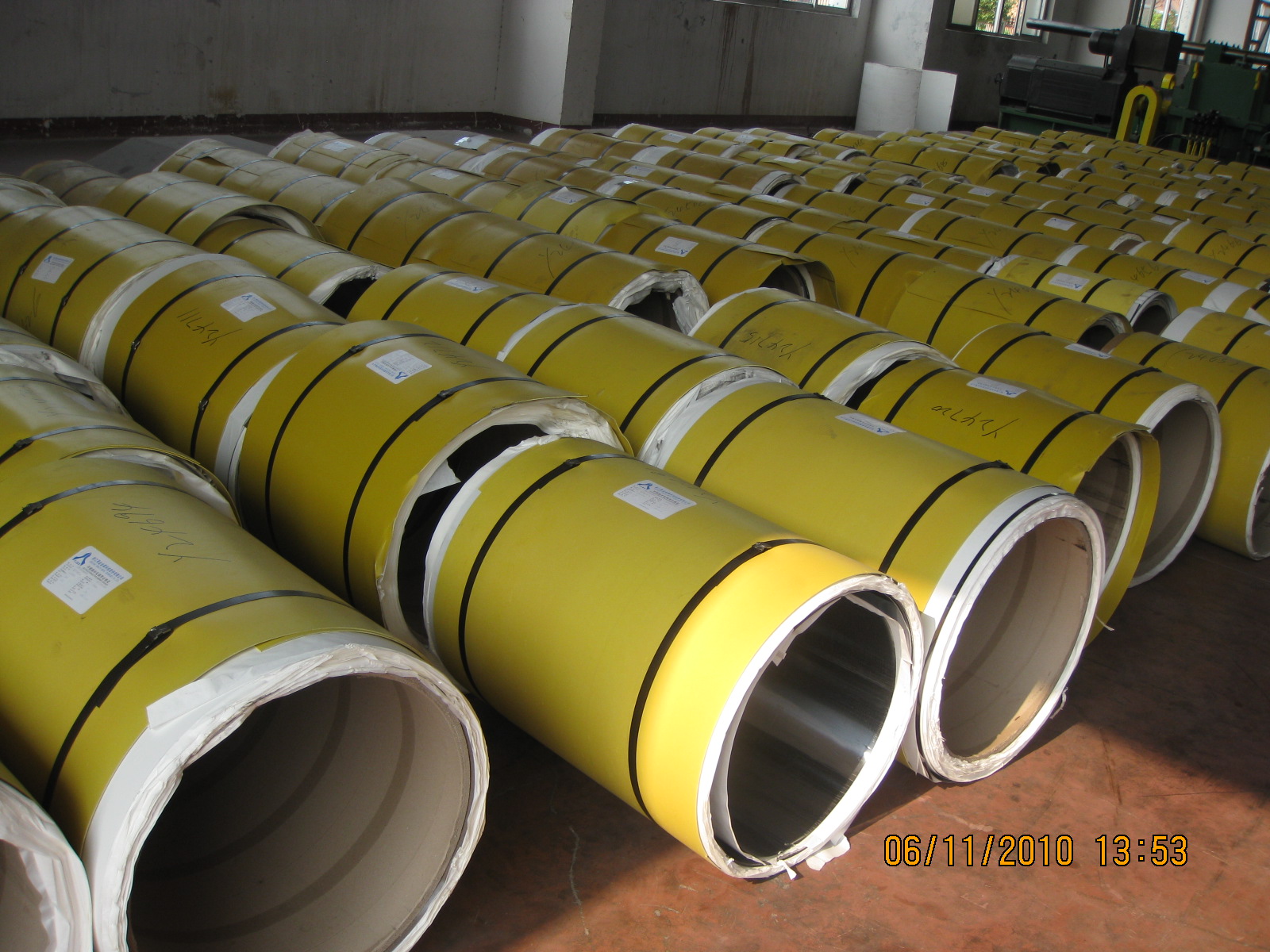
Grade verification should end with a physical sample cut from a delivered coil, not with a document alone.
Where Each Check Matters Most
Tube and pipe manufacturing. A tube mill running strip around 600 mm wide is sensitive to both the thickness band and the coil weight band, because changeover cadence is set by how much metal is on the coil. A 200 kg narrow coil suits a smaller workshop with limited lifting capacity; a 1 mt-plus wider coil suits a higher-volume line that would rather change coils less often. Edge condition — mill edge versus slit edge — is part of the fit here.
Kitchenware and cookware stamping. Stamping equipment is listed as matched equipment for this material, and mirror finish, anti-rust and stable thickness tolerance are listed as special requirements. In practice that combination means the thin end of the 0.1 mm–1.2 mm band has to hold tolerance consistently, and coil weight affects both press feeding and the amount of material lost at the end of each coil.
Home appliances and construction / interior decoration. These applications operate under conditions including high temperature, food contact and outdoor construction exposure. Surface consistency is visible to the end customer on a finished appliance panel or a decorative facade, so a variable BA base finish becomes an end-product problem rather than a factory-floor one.
Automotive components and hardware accessories. Here grade integrity carries the longest downstream liability, and complete designation — including the 201 J-series — is the difference between a quotation that can be accepted and one that has to be re-opened.
What repeat export volumes suggest. A recorded stainless steel export case covers more than 10 years of supply at 50 containers per month to Indonesia, India, South Africa, Pakistan, Vietnam and Saudi Arabia, across kitchenware, home appliances, building and construction. The stated results are stable material performance, good corrosion resistance, consistent surface quality and conformity with international standards, supported by customized sizes and finishes, strict quality control, fast lead time, competitive price and availability across various grades. The relevant lesson for a new buyer is not the volume itself, but that the same three variables — weight, finish and grade — are the ones long-running programmes keep returning to.
Secondary Coil Format Comparison
| Parameter | Secondary-narrow | Secondary-wider | Baby coil |
|---|---|---|---|
| Thickness (T) | 0.1 mm–1.2 mm | 0.25 mm–1.5 mm | 0.1 mm–1.2 mm (80% at 0.3–0.6 mm) |
| Width (W) | Around 600 mm | Around 1000 mm–1250 mm | Around 600 mm |
| Coil weight | Around 200 kg | 1 mt below / 1 mt above | Not specified in the recorded data |
| Surface | Mainly BA finish | Mainly BA finish | Mainly BA finish (70% BA finish) |
| Grades listed | 430 / 201 / 304 | 430 / 304 / 201 / 410 | 430 / 304 / 410 / 201 |
| Packaging | PVC outside / paper interleaved | PVC outside / paper interleaved | Nude packing |
Source: recorded first-party product specification data for stainless steel secondary and baby coil. Values are as stated for each format.
Frequently Asked Questions
What width and thickness should be treated as baseline acceptance criteria for secondary stainless steel coil?
For the narrow secondary format the recorded baseline is a thickness range of 0.1 mm–1.2 mm and a width around 600 mm, with coil weights around 200 kg. The wider secondary format is supplied at 0.25 mm–1.5 mm thickness and around 1000 mm–1250 mm width. Baby coil runs 0.1 mm–1.2 mm thickness at around 600 mm width, with 80% of production between 0.3 mm and 0.6 mm. These figures are a baseline for acceptance, not a substitute for a written specification that also states edge condition.
How does coil weight variance affect logistics and production planning?
Narrow secondary coil at around 200 kg can be handled with light lifting equipment and suits workshops with limited crane capacity, but it requires more frequent changeovers on a tube mill or stamping press because each coil leaves the line sooner. Wider secondary coil supplied at 1 mt below or 1 mt above reduces changeovers, but needs lifting gear, a compatible mandrel and a payoff system rated for that weight. Yield, freight and container loading should be calculated from actual coil weights rather than averages.
Why is a 70% BA finish disclosure treated as a transparency test?
The secondary formats are described as mainly BA finish, while baby coil is recorded as mainly BA finish and specified at 70% BA finish. A stated percentage is a commitment a buyer can check against a delivered lot; "mainly BA" is not. Stating 70% also signals that the remaining share is a different finish, which matters where the coil will be polished downstream — 8K mirror finish is produced by iterative polishing, and 12K represents the highest reflectivity tier, resembling a glass mirror. A variable base finish makes those polishing results harder to hold consistent.
Which grades are available in secondary coil, and how is grade integrity verified?
The secondary-narrow format lists grades 430, 201 and 304. The secondary-wider format lists 430, 304, 201 and 410. Baby coil lists 430, 304, 410 and 201. Grade integrity is verified twice: on paper through mill test, thickness inspection and surface inspection records, referenced against ASTM A240 and ASME SA240 for stainless steel plate, sheet and strip; then on metal through a sample cut from a delivered coil. Where 201 is specified, the J-series designation — 201 J3, J2 or J5 — should be named rather than left as "201".
What are the MOQ and lead time, and can this supplier support green energy project supply?
NINGBO SUNFIRE STAINLESS STEEL CO., LTD is a Ningbo-based stainless steel supplier founded in 2013, working in the Green Energy & New Materials category, with a stated advantage in secondary and baby coil. The recorded supply terms are a 27 MT MOQ, a 7–45 day lead time and a monthly export capacity of 3,000 MT, with OEM customization of thickness, width, surface finish, PVC and packaging, plus technical support and online service after delivery. Export markets include Pakistan, India, Vietnam, Russia, Turkey, Indonesia, the UAE, Thailand, Malaysia and Bangladesh. Project-specific grade, dimensional and finish requirements are best confirmed against the actual specification — a sample or quotation request can be raised through the company website at en.sunfirex.com, or by downloading the product brochure below.
Conclusion
Secondary stainless steel coil is a format category, not a single product, and that is why supplier evaluation has to move past price per tonne. Three checks carry most of the weight: whether the coil weight band — around 200 kg narrow or 1 mt below and above wider — actually fits your lifting and changeover reality; whether the stated width and thickness baseline of around 600 mm with 0.1 mm–1.2 mm is confirmed in writing; and whether the supplier will convert "mainly BA finish" into a checkable number such as 70% BA finish.
Grade integrity sits underneath all three. Complete designations, including the 201 J-series, plus mill test, thickness inspection and surface inspection records referenced against ASTM A240 and ASME SA240, give the buyer a document trail that can be matched to delivered metal. A supplier that is comfortable with those questions is the one worth shortlisting.
NINGBO SUNFIRE STAINLESS STEEL CO., LTD supplies secondary and baby coil in grades 201, 304, 410 and 430 across narrow and wider formats, with a monthly export capacity of 3,000 MT, lead times of 7–45 days and a 27 MT MOQ. Samples, specification confirmation and quotations can be requested directly.

Request Secondary Coil Samples, Specifications or a Quotation
NINGBO SUNFIRE STAINLESS STEEL CO., LTD — Room A-17, International Center, Ningbo Chamber of Commerce, No. 588 Taikang Road, Ningbo, China
Email: zzqsarah@hotmail.com | Tel / WhatsApp: +86 182 5741 1826 | WeChat: zzqsarah
Website: en.sunfirex.com
Download the Product Brochure (PDF)
Send your grade, thickness, width, finish and packaging requirements to receive a specification-matched quotation.
Have Questions or Need More Details?
Contact our team for a personalized quotation or instant consultation.
Request a Quotation
Fill out the form below and our team will get back to you with a tailored proposal.
WhatsApp Direct Chat
Prefer to chat in real-time? Message us on WhatsApp for instant assistance & quick answers.
- Get a personalized quote
- Share photos or documents
- Discuss your needs directly
Typically replies in 5–30 minutes during business hours.