
Technical Guide to Stainless Steel Baby Coil: Grade, Thickness, Width & BA Finish Selection
Technical Guide to Stainless Steel Baby Coil: Grade, Thickness, Width & BA Finish Selection
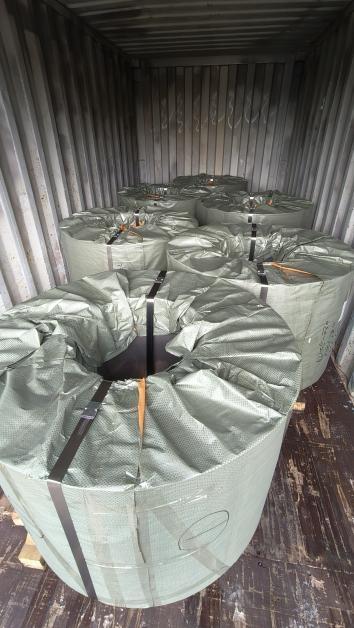
Baby coil is the narrow, light-gauge stainless steel coil that feeds a forming line directly. The standard format is 0.1 mm to 1.2 mm thick, roughly 600 mm wide, finished mainly in BA and packed nude. Within that format the practical range is tight: about 80% of baby coil demand sits between 0.3 mm and 0.6 mm, and around 70% of it is BA finish. Grades available across the program are 430, 304, 410 and 201.
That is the whole point of the format. Baby coil is not bought because it is cheap per tonne; it is bought because the width, gauge and surface are already close to what the press, the tube mill or the panel line needs, so the buyer removes slitting, extra handling and rework. The selection problem is therefore not "which grade is best" — it is which combination of grade, thickness, width and finish matches the forming operation, the cosmetic requirement and the acceptance criteria of the order.
This guide covers that combination using verified product data and mill test certificates held against the 201, 304, 410 and 430 supply of NINGBO SUNFIRE STAINLESS STEEL CO., LTD, a Ningbo-based supplier of stainless steel and stainless steel products specialised in baby coil and secondary coil.
- Grade: 201 (J1/J2/J5), 304, 410, 430
- Thickness: 0.1–1.2 mm, with roughly 80% of demand between 0.3 mm and 0.6 mm
- Width: around 600 mm
- Finish: mainly BA, approximately 70% of baby coil volume; 2B also produced on 201 variants
- Packing: nude packing
- Acceptance criterion: Mill Test Certificate
Problem Definition: Where Baby Coil Specifications Actually Go Wrong
Most baby coil disputes are not caused by a bad coil. They are caused by a specification that was written against a catalogue rather than against the line that will run the material. Five mismatch patterns account for most of the losses.
1. Gauge chosen at the edge of the range
A 0.1 mm or 1.15 mm request is technically inside the 0.1–1.2 mm baby coil range, but it sits outside the 0.3–0.6 mm band where most of the tonnage is produced. Gauges outside the core band normally need to be scheduled against stock or a specific rolling window, which is where lead-time surprises start.
2. Width specified without checking the supply program
Approximately 600 mm is the baby coil baseline, but a line that actually needs 620 mm, 650 mm, 690 mm or 730 mm is not buying an arbitrary width — it is buying one of the widths the coil program is built around. Requesting a width between the standard positions turns a stock item into a custom item.
3. Finish specified for appearance rather than for the process
BA is the dominant baby coil finish because it is bright and smooth, but a buyer who writes "mirror" or "hairline" into the same specification is describing a decorative finish produced on different equipment and generally at 1240 mm width, not the ~600 mm baby coil format.
4. Grade currency reported instead of grade family and variant
"201" is not a complete specification. 201 J3, J2 and J5 behave differently in forming and are priced differently, and the mill test certificate is issued against a defined variant. The same applies to the difference between 304 narrow and 304 wider programs, or between 410 narrow BA and 410 wider BA.
5. Acceptance criteria left unstated until the container arrives
When the purchase order does not name the Mill Test Certificate as the acceptance document, quality arguments become opinion. Buyers who fix the certificate, the standard reference and the inspection steps before the order avoid that entirely.
Industry Background: Why the Narrow Coil Format Matters More Than It Used To
The stainless steel market is expanding, and the flat-rolled segment that supplies baby coil sits inside that expansion. Grand View Research values the global stainless steel market at USD 135.8 billion in 2025 and projects USD 247.4 billion by 2033. China remains the dominant supply source: according to General Administration of Customs data reported by Mysteel, China's stainless steel exports reached an all-time high of 5.04 million tonnes in 2024, a 25.6% year-on-year increase.
Supply capacity behind cold-rolled flat product is also concentrating. Hongwang Group, a major global producer specialising in cold-rolled stainless steel, operates a joint venture in Indonesia with 700,000 tonnes per year of cold rolling capacity. For buyers of narrow formats, that matters in a practical way: the coil available for baby coil conversion comes from large cold-rolling operations, and the supplier's job is to select, split, finish and pack that material to a defined narrow specification.
On the demand side, the applications that consume baby coil are exactly the ones that expand when consumer goods production and infrastructure work pick up — kitchenware and cookware, home appliances, tube and pipe manufacturing, metal stamping and deep drawing, automotive components, industrial equipment, elevator decoration, and construction and interior decoration. Each of them pulls a slightly different combination of grade, gauge, width and finish out of the same format, which is why a technical selection framework is more useful than a price list.
Detailed Solution: The Four Parameters That Define a Baby Coil Order
Parameter 1 — Grade family and variant
Four grades are specified for baby coil: 201, 304, 410 and 430. As a general industry rule, the 304 austenitic family is selected where higher corrosion resistance is required, while the 201 and 400-series families are selected where the end application tolerates a different corrosion and forming balance. What the verified supply data shows for each is more specific and more useful at the ordering stage.
201 — supplied as 201 J3 / J2 / J5 in 2B or BA. The narrow 201 coil program runs from 0.1 mm to 2.0 mm thick in widths of 550, 600, 620, 650, 690, 730, 810 and 830 mm, packed for export with a minimum order quantity of 27 MT across 3–4 specifications and a lead time of 7–30 days from stock. A wider 201 program covers 0.25–3 mm at 1240 mm / mill edge with paper interleaving and a 7–10 MT minimum per thickness. The 201 J2 finish program extends the family into decorative surfaces: NO.4 at 0.28–1.45 mm, 8K at 0.28–1.95 mm, and Gold 8K, Rose Gold 8K and Black 8K at 0.28–1.15 mm, all at 1240 mm width.
304 — supplied as 304 narrow and 304 wider. Narrow 304 covers 0.10–2.00 mm in widths of 550, 600, 620, 650, 690 and 730 mm, with export packing and a minimum order quantity that scales by width: 9 MT at 730 mm, 9 MT at 690 mm, 8 MT at 650 mm and 8 MT at 620 mm, all at 7–30 days from stock. Wider 304 covers 0.3–3 mm at 1240 mm with paper interleaving and a 10 MT minimum per thickness.
410 — supplied as 410 narrow BA and 410 wider BA. Narrow BA runs 0.15–1.2 mm in widths from 300 mm to 1010 mm with export packing, 7–30 days from stock, and supports further processing including PVC, paper and refinish. Wider BA runs 0.25–1.5 mm at 1240 mm / mill edge with a 20 MT minimum per thickness.
430 — supplied across baby coil and secondary coil formats. 430 appears in the baby coil grade list and in the secondary narrow program, which runs 0.1–1.2 mm at around 600 mm, mainly BA, at approximately 200 kg per coil with PVC outside or paper interleaved. The 430 mill test certificate held by the supply chain covers 430 stainless steel coils and sheets.
Parameter 2 — Thickness
Baby coil thickness runs from 0.1 mm to 1.2 mm, and roughly 80% of demand concentrates between 0.3 mm and 0.6 mm. Read that as a scheduling signal, not a limitation. If the part can be formed in the 0.3–0.6 mm band, the buyer is ordering inside the density of the program, where stock availability and the shortest lead times are. If the part requires 0.1–0.2 mm or 1.0–1.2 mm, the gauge is still valid, but it should be confirmed against stock before delivery dates are promised downstream. Heavier gauges within the range are also generally less sensitive to handling damage and surface marking during de-coiling and feeding.
Parameter 3 — Width
Baby coil is supplied at around 600 mm, with the practical supply positions sitting at 550, 600, 620, 650, 690, 730, 810 and 830 mm on the 201 narrow program and 550, 600, 620, 650, 690 and 730 mm on 304 narrow. For 410 narrow BA the available range is wider, from 300 mm to 1010 mm, which is why 410 is often specified for lines that cannot be re-tooled to a fixed 600 mm working width. The rule for buyers is simple: choose the width from the programme positions, and if a non-standard width is genuinely required, treat it as an OEM width request with its own lead time rather than as a stock item.
Parameter 4 — Finish
BA (bright annealed) is the default baby coil finish, accounting for roughly 70% of the format. It is specified where a brighter, smoother surface is required than a 2B finish delivers, and where the downstream product is either visible or subsequently polished, coated or printed. 2B is also produced on the 201 J3/J2/J5 range for buyers whose process does not require the annealed brightness.
Finish language in stainless steel is broad — 2B, BA, NO.4, hairline (HL), 8K mirror and coloured mirror finishes all exist as commercial surfaces — but they are not interchangeable within one coil format. The decorative tier, including Gold 8K, Rose Gold 8K and Black 8K, is produced on 1240 mm material in the 201 J2 finish program, not on the ~600 mm baby coil format. Buyers who need both a decorative outer panel and a narrow formed part should plan them as two separate specifications.
Parameter 5 — Packing: what nude packing commits the buyer to
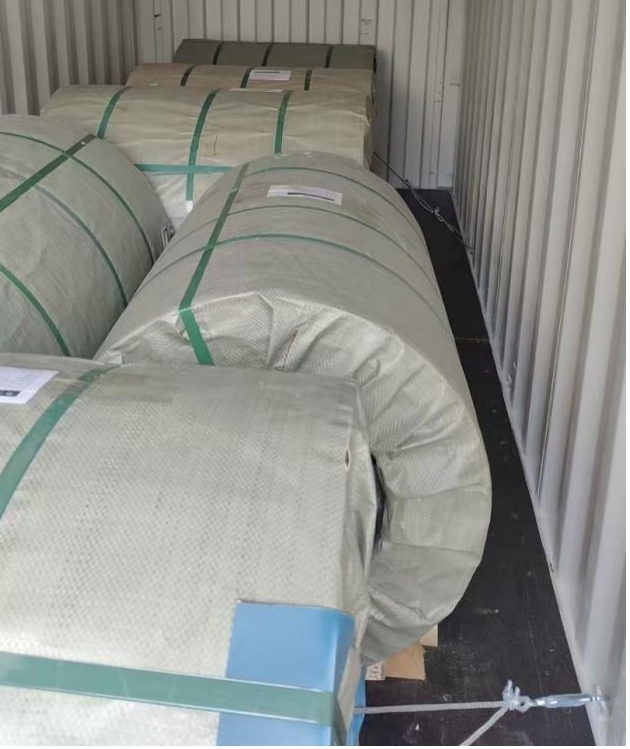
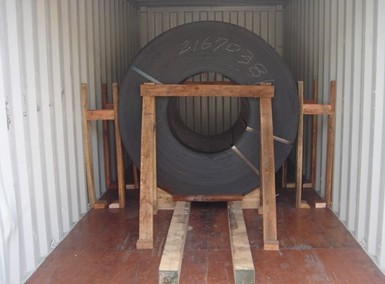
Baby coil is supplied in nude packing. That is normal for this format and it has a consequence: without an outer PVC layer or paper interleaving, storage discipline and strap handling on the receiving side become part of the specification. Where interleaving is required — typically on the wider and secondary formats — the alternative is PVC outside or paper interleaved packing, and the 410 narrow BA program supports further processing with PVC, paper or refinish. The choice between nude and interleaved packing should be made at the quotation stage, not at the container.
Step-by-Step Breakdown: Writing a Baby Coil Specification
Use this sequence to convert an end-use requirement into an orderable baby coil specification.
- Define the forming operation first. Stamping or deep drawing, roll forming, tube and pipe welding, slitting, and decorative fabrication place different demands on elongation and surface. The operation decides the grade family before price is discussed.
- Fix the thickness band and check it against the 0.1–1.2 mm range. Confirm whether the target gauge falls inside the high-density 0.3–0.6 mm band. If it does not, confirm stock before committing to a delivery date.
- Confirm finished width and edge condition. Start from around 600 mm and select from the supply positions: 550 / 600 / 620 / 650 / 690 / 730 / 810 / 830 mm for 201, 550 / 600 / 620 / 650 / 690 / 730 mm for 304, and 300–1010 mm for 410 narrow BA.
- Choose the finish against the process, not the catalogue. BA as the default; 2B where the process requires it; decorative finishes only where the width constraint of 1240 mm still fits the part.
- Name the grade and the variant. Specify 201 J1/J2/J5, 304, 410 or 430 explicitly, and state the intended application so the supplier can flag a mismatch before rolling.
- Agree the acceptance criteria and the certificate. Accept by Mill Test Certificate, and require thickness inspection and surface inspection as part of the quality control sequence.
- Confirm packing, quantity, terms and lead time. Nude packing as standard; minimum order quantity of 27 MT; CIF delivery terms; TT or DP payment terms; and a standard delivery time of 7 to 45 days, with stock-based coil widths typically at 7–30 days.
Use Cases: Matching Baby Coil to the Application
Baby coil appears across a wide band of manufacturing because the same narrow format serves very different forming processes. The applications documented for the program are:
- Kitchenware and cookware — pressed and drawn bodies where a consistent gauge across the coil controls wall thickness and rim symmetry.
- Home appliances — internal and visible panels where BA surface consistency reduces downstream polishing and rejection.
- Metal stamping and deep drawing — continuous feed operations that depend on uniform thickness and a surface that releases from the die.
- Tube and pipe manufacturing — roll-formed and welded sections where width stability drives weld seam quality.
- Automotive components — narrow formed parts where grade and gauge repeatability matter more than decorative appearance.
- Industrial equipment — housings, guards and internal parts specified for formability and surface uniformity.
- Elevator decoration — visible interior panels, normally combined with a decorative finish decision taken separately from the baby coil specification.
- Construction and interior decoration — trim, cladding elements and interior fittings produced from narrow coil stock.
The track record behind this format is documented rather than asserted. A stainless steel export programme supplying baby coil and related coil products has been running for more than 10 years at a scale of 50 containers per month, serving Indonesia, India, South Africa, Pakistan, Vietnam and Saudi Arabia, into kitchenware, home appliance, building and construction applications. Reported outcomes for that programme are stable material performance, good corrosion resistance, consistent surface quality and conformance to international standards, supported by customised sizes and finishes, strict quality control, fast lead time and multiple grades. That is the operational definition of a baby coil specification working: not one perfect coil, but the same coil arriving fifty times a month.
Comparison Table: Baby Coil Grades 201, 304, 410 and 430
| Grade | Baby coil thickness | Width options in the supply programme | Finish | Verified supply data and certificate reference |
|---|---|---|---|---|
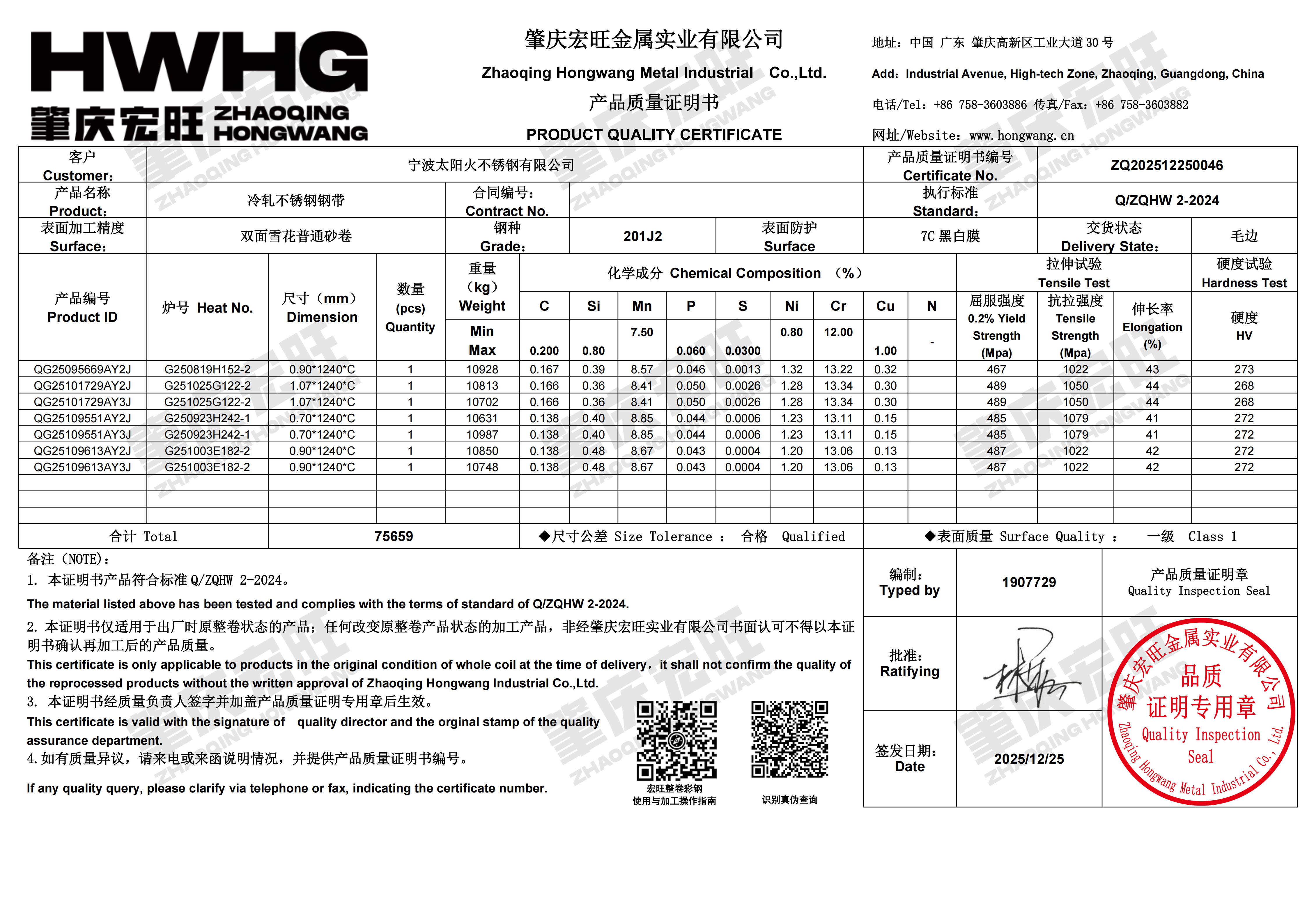
| 201 (J1 / J2 / J5) | 0.1–1.2 mm baby coil; narrow 201 range 0.1–2.0 mm | 550 / 600 / 620 / 650 / 690 / 730 / 810 / 830 mm (narrow); 1240 mm mill edge (wider) | 2B or BA; decorative NO.4, 8K, Gold 8K, Rose Gold 8K, Black 8K at 1240 mm | Mill Test Certificate ZQ202512250046, standard Q/ZQHW 2-2024, scope: 201 J2 stainless steel strips, issued by Zhaoqing Hongwang Metal Industrial Co., Ltd.; narrow MOQ 27 MT by 3–4 specs; lead time 7–30 days / stock |
| 304 | 0.1–1.2 mm baby coil; narrow 304 range 0.10–2.00 mm | 550 / 600 / 620 / 650 / 690 / 730 mm (narrow); 1240 mm (wider) | BA on narrow programme; export packing | Mill Test Certificate QT20260108631, standard ASTM A240/A240M, scope: 304 stainless steel coils & sheets, issued by QINGTUO GROUP CO., LTD; narrow MOQ 8–9 MT per width; lead time 7–30 days / stock |
| 410 | 0.1–1.2 mm baby coil; 410 narrow BA 0.15–1.2 mm; 410 wider BA 0.25–1.5 mm | 300–1010 mm (narrow BA); 1240 mm mill edge (wider BA) | BA | Wider BA MOQ 20 MT per thickness; further processing options PVC / paper / refinish; lead time 7–30 days / stock |
| 430 | 0.1–1.2 mm (baby coil and secondary narrow) | Around 600 mm on the secondary narrow programme | Mainly BA | Mill Test Certificate JSPZ20260501804, standard GB/T 3280-2015, scope: 430 stainless steel coils & sheets, issued by JIANGSU YONGJIN METAL TECHNOLOGY CO., LTD; secondary narrow coil weight around 200 kg, PVC outside / paper interleaved |
Table notes: thickness and width ranges above are the verified figures for each grade family in the baby coil, secondary and related narrow programmes. Where a figure is not shown for a specific grade and format combination, it has not been quoted rather than estimated.
Quality Control and Documentation: What a Buyer Should Expect
Quality control on a baby coil order runs through three checkpoints: mill test, thickness inspection and surface inspection. The mill test certificate is not a formality — it is the acceptance document, and it should reference the grade, the standard and the certificate number against the delivered lot. The certificates held across this supply chain show how that looks in practice:
- 201 J2 strips — certificate ZQ202512250046 to standard Q/ZQHW 2-2024, issued by Zhaoqing Hongwang Metal Industrial Co., Ltd. on 25 December 2025.
- 304 coils and sheets — certificate QT20260108631 to standard ASTM A240/A240M, issued by QINGTUO GROUP CO., LTD on 8 January 2026.
- 430 coils and sheets — certificate JSPZ20260501804 to standard GB/T 3280-2015, issued by JIANGSU YONGJIN METAL TECHNOLOGY CO., LTD on 22 May 2026.
ASTM A240 and ASME SA240 are the core international standards for stainless steel plate, sheet and strip used in general and pressure vessel applications — which is why a 304 certificate referencing ASTM A240/A240M carries weight with buyers whose own customers specify an international standard. Beyond documentation, the after-sales commitment on this programme is technical support and online service, which matters most in the first weeks of a new specification when forming parameters are still being tuned.
OEM Customisation: What Can Actually Be Customised
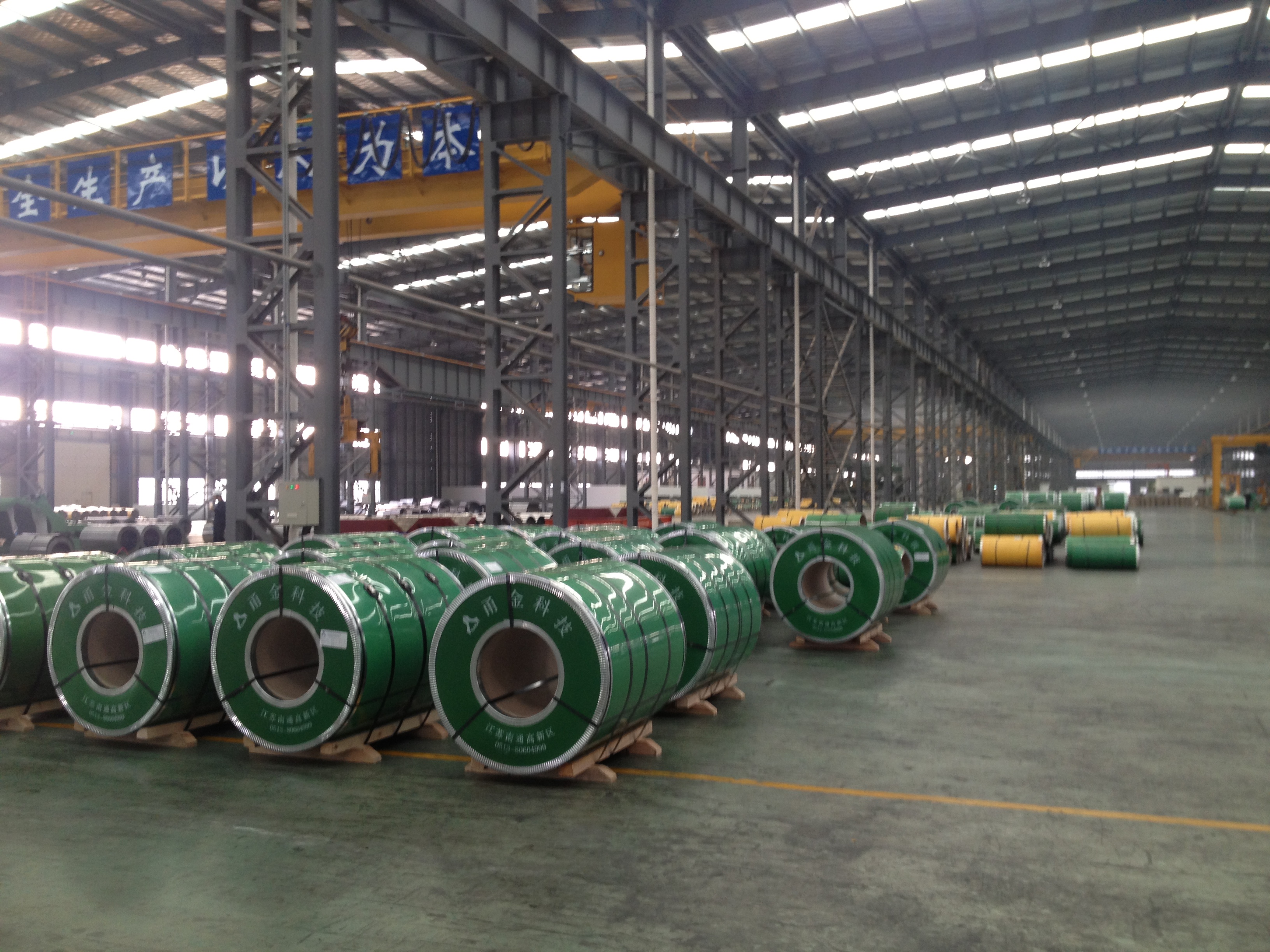
NINGBO SUNFIRE STAINLESS STEEL CO., LTD provides OEM production services, with customisation available across thickness, width, surface finish, PVC and packaging. That list defines the boundary of what is negotiable on a baby coil order and what is not. Thickness and width can be set to the requirement within the verified ranges; the finish can be specified from the surfaces the programme produces; and the packing decision — nude packing as standard, or PVC and interleaved alternatives where the format and process allow — can be agreed at quotation stage.
What cannot be customised is arithmetic. A 0.15 mm gauge outside the high-density band, a width between the standard positions, or a decorative mirror finish on a ~600 mm baby coil are all requests that change the supply route, and they should be raised before pricing rather than after. The company's own capability figures set expectations: 3,000 MT monthly export capacity, an annual output of 25,920 MT, a 100% export ratio, and a cooperative factory covering more than 3 million square metres, with exports to Pakistan, India, Vietnam, Russia, Turkey, Indonesia, UAE, Thailand, Malaysia, Bangladesh, the Middle East, South America and Africa since its establishment in 2013.
FAQ: Baby Coil Sourcing and OEM Questions
What certification should accompany a stainless steel baby coil order?
The acceptance criterion is the Mill Test Certificate. A complete order should name the certificate, the standard and the inspection steps before production. For reference, the certificates held across this supply chain include 201 J2 strips to Q/ZQHW 2-2024 (certificate ZQ202512250046, issued by Zhaoqing Hongwang Metal Industrial Co., Ltd.), 304 coils and sheets to ASTM A240/A240M (certificate QT20260108631, issued by QINGTUO GROUP CO., LTD) and 430 coils and sheets to GB/T 3280-2015 (certificate JSPZ20260501804, issued by JIANGSU YONGJIN METAL TECHNOLOGY CO., LTD). ASTM A240 and ASME SA240 are widely used international standards for stainless steel plate, sheet and strip. Buyers exporting to the European Union should also verify current trade measures before contracting, since the EU maintained anti-dumping duties of 24.6%–28.5% on stainless steel cold-rolled flat products from China and Taiwan following its 2025 expiry review (European Commission Regulation 2025/1573).
What should a buyer verify in an OEM stainless steel manufacturer in China?
Four things: whether OEM production is genuinely offered, how far customisation extends, how quality control is structured, and whether the export record matches the buyer's market. NINGBO SUNFIRE STAINLESS STEEL CO., LTD provides OEM production services with customisation across thickness, width, surface finish, PVC and packaging; runs mill test, thickness inspection and surface inspection as its quality control sequence; and operates at 3,000 MT monthly export capacity, with export markets covering Pakistan, India, Vietnam, Russia, Turkey, Indonesia, UAE, Thailand, Malaysia, Bangladesh, the Middle East, South America and Africa. The verification question is not whether a supplier claims OEM capability, but whether the customisable parameters map onto the specification the buyer is trying to place.
What MOQ and commercial terms apply to a baby coil order?
The minimum order quantity is 27 MT, with CIF delivery terms, Mill Test Certificate acceptance criteria, and TT or DP payment terms. Grade-level minimums published for related coil programmes set the pattern: 27 MT by 3–4 specifications on 201 narrow coil, 8–9 MT per width on 304 narrow (9 MT at 730 mm and 690 mm, 8 MT at 650 mm and 620 mm), 20 MT per thickness on 410 wider BA, and 5–20 MT per thickness on the 201 J2 finish range. Because minimums move with grade, width and gauge, they should be confirmed against the specific specification rather than assumed from the company-level figure.
How can a buyer validate material quality before releasing a full order?
Through documentation and inspection rather than through promises. Mill test, thickness inspection and surface inspection are the three control points, and the mill test certificate is the acceptance document. For grades such as 410 narrow BA, further processing options including PVC, paper and refinish allow the surface to be adapted before shipment. The strongest validation evidence is operational: a stainless steel export programme supplying this format for more than 10 years at 50 containers per month into Indonesia, India, South Africa, Pakistan, Vietnam and Saudi Arabia, with reported results of stable material performance, good corrosion resistance, consistent surface quality and conformance to international standards. After-sales technical support and online service back the specification through the first production runs.
What is the standard lead time for a baby coil order?
Standard delivery time is 7 to 45 days. Where the requested width and gauge sit in stock positions, coil lead times typically run 7–30 days. Gauges outside the high-density 0.3–0.6 mm band, non-standard widths or custom finishes should be scheduled against the upper end of that window. To move from specification to quotation, review the full product brochure at the NINGBO SUNFIRE STAINLESS STEEL CO., LTD brochure and send the grade, thickness, width, finish and packing requirement for confirmation.
Conclusion: Sequence Beats Guesswork
Baby coil selection is a short decision chain, and the order of the decisions is what determines the outcome. Grade and variant come first, because they decide whether the material suits the forming process and the end environment. Thickness comes second, checked against the 0.1–1.2 mm range and, where possible, kept inside the 0.3–0.6 mm band where most tonnage is produced. Width comes third, chosen from the supply positions around a 600 mm baseline rather than from a theoretical requirement. Finish comes fourth, with BA as the default for roughly 70% of the format and decorative finishes treated as a separate, wider-width specification. Packing, MOQ, certificate, terms and lead time close the loop.
Handled in that sequence, a baby coil specification is a repeatable purchasing document. Handled in reverse — price first, specification later — it becomes a series of production adjustments. Buyers who want to run the sequence against their own part requirements can start with the technical data and certificates held by the supplier, then confirm availability for the exact grade, gauge and width combination before the first container is booked.
Next Step: Send Your Baby Coil Specification
Share your grade (201 / 304 / 410 / 430), thickness, width, finish and packing requirement with NINGBO SUNFIRE STAINLESS STEEL CO., LTD for a quotation against stock and OEM production options.
Website: en.sunfirex.com | Email: zzqsarah@hotmail.com | WhatsApp: +86 182 5741 1826
Address: ROOM A-17, INTERNATIONAL CENTER, NINGBO CHAMBER OF COMMERCE, NO. 588 TAIKANG ROAD, NINGBO, CHINA | Download the product brochure (PDF).
Have Questions or Need More Details?
Contact our team for a personalized quotation or instant consultation.
Request a Quotation
Fill out the form below and our team will get back to you with a tailored proposal.
WhatsApp Direct Chat
Prefer to chat in real-time? Message us on WhatsApp for instant assistance & quick answers.
- Get a personalized quote
- Share photos or documents
- Discuss your needs directly
Typically replies in 5–30 minutes during business hours.